
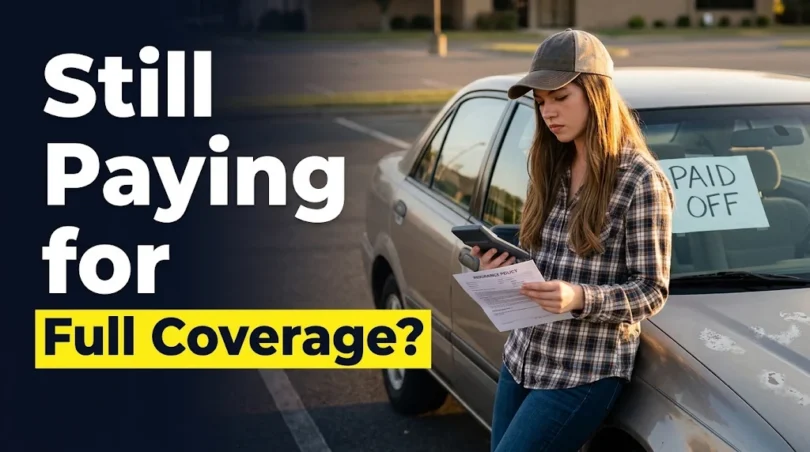

Liability only insurance pays for damage and injuries you cause to other people, but nothing for your own car. Full coverage usually means liability plus collision and comprehensive, which pay to repair or replace your car after a crash, theft, hail or other damage. Full coverage costs a lot more, nearly double on average. It usually makes sense to drop it when your car is paid off, worth only a few thousand dollars, and you could afford to replace it yourself.
In late 2026, the national average was about $187 a month for full coverage and $99 a month for liability only, according to Insurify. That roughly $1,000 a year difference is real money. Here is how to decide which one fits your situation.
What “Full Coverage” Really Means
There is no single policy called full coverage. It is an informal term for a combination of coverages:
- Liability: bodily injury and property damage you cause to others, required in nearly every state
- Collision: damage to your car from hitting another vehicle or object, or rolling over, regardless of fault
- Comprehensive: damage to your car from things other than collisions, like theft, vandalism, fire, hail, flooding, falling objects and hitting an animal
Full coverage policies often also include uninsured motorist coverage, medical payments or personal injury protection, depending on your state and choices.
What Liability Only Covers
Liability only covers the other side when you are at fault:
- Their medical bills, lost wages and pain and suffering
- Repairs to their car or property, like a fence or storefront
- Your legal defense if you are sued
It does not pay to fix your car, replace it if it is stolen, or cover hail or flood damage. If you cause a crash, you pay for your own repairs entirely.
Side by Side
| Situation | Liability only | Full coverage |
|---|---|---|
| You cause a crash and injure another driver | Covered up to your limits | Covered up to your limits |
| You cause a crash and damage your own car | Not covered | Covered by collision, minus deductible |
| Your car is stolen | Not covered | Covered by comprehensive |
| Hail dents your car | Not covered | Covered by comprehensive |
| You hit a deer | Not covered | Covered by comprehensive |
| Another driver hits you | Their liability pays your car damage | Their liability pays, or your collision can pay faster |
| Average cost late 2026 | About $99 a month | About $187 a month |
When You Must Keep Full Coverage
- Your car is financed or leased. Lenders and leasing companies require collision and comprehensive to protect their investment.
- You couldn’t afford to replace your car. If losing it would leave you without transportation and no savings to replace it, full coverage protects you.
- Your car is newer or valuable. Repair costs on newer cars with sensors and cameras can be very high, even after minor crashes.
When Dropping Full Coverage Makes Sense
- The car is paid off
- Its market value is low, often a few thousand dollars or less
- You have enough savings to repair or replace it
- The cost of collision and comprehensive is high compared with what they would pay out
The Math: Is Full Coverage Worth It?
Step 1: Find your car’s value
Look up your car’s private party or trade in value on a pricing guide like Kelley Blue Book or Edmunds. Use honest condition and mileage.
Step 2: Find what collision and comprehensive cost
Ask your insurer for the yearly cost of those two coverages alone, or check your declarations page.
Step 3: Subtract your deductible
The most collision or comprehensive could pay is your car’s value minus your deductible. A $3,000 car with a $1,000 deductible could pay at most $2,000.
Step 4: Compare
A common rule of thumb is to consider dropping full coverage when its yearly cost is more than about 10 percent of the car’s value. Another way to look at it: if you would pay more in premiums over two or three years than the maximum payout, liability only may make more sense.
| Example | Car value | Collision and comprehensive per year | Max payout after $1,000 deductible | Verdict |
|---|---|---|---|---|
| Newer SUV | $28,000 | $1,100 | $27,000 | Keep full coverage |
| 8 year old sedan | $9,000 | $850 | $8,000 | Probably keep, depends on savings |
| 15 year old hatchback | $3,000 | $700 | $2,000 | Consider dropping |
A Middle Ground: Keep Comprehensive, Drop Collision
Comprehensive is often much cheaper than collision. If you live somewhere with frequent hail, flooding, wildlife or car theft, keeping comprehensive while dropping collision can protect you against those risks at a lower cost. Some insurers require you to carry collision with comprehensive, but many allow comprehensive alone.
You can also raise your deductibles to $1,000 or more to make full coverage cheaper if you aren’t ready to drop it.
Don’t Cut Liability Limits
When drivers switch to liability only, some also lower their liability limits to the state minimum to save more. That is risky. State minimums in many places are $25,000 per person for injuries or even less. A serious crash can create medical bills and lost wages far above that, and you can be held personally responsible for the difference. Keeping higher liability limits, such as 100/300/100, costs relatively little extra and protects your income and savings.
Keep Uninsured Motorist Coverage Too
Liability only covers others, not you. If an uninsured or underinsured driver injures you, uninsured motorist coverage pays your medical bills, lost wages and pain and suffering. In some states, uninsured motorist property damage coverage can also pay to fix your car when the other driver has no insurance, which is especially useful if you drop collision.
What About Gap Insurance?
If you still owe more on your loan than your car is worth, gap insurance covers the difference if the car is totaled or stolen. It only makes sense with full coverage on a financed or leased car. Once your loan balance falls below the car’s value, you can drop it.
A Quick Example
Luis drives a paid off 2011 sedan worth about $3,500. His full coverage costs $1,950 a year, and collision and comprehensive make up $780 of that, with a $500 deductible. The most those coverages could pay is $3,000. He has $5,000 in emergency savings. He drops collision, keeps comprehensive because hail is common in his area, keeps 100/300/100 liability limits and uninsured motorist coverage, and saves about $550 a year. If his car is totaled in a crash he causes, he can use his savings and the money he saved on premiums to buy another used car.
How Claims Work Without Collision Coverage
If another driver hits you and you only have liability coverage, you file a claim with their insurer. Their property damage liability should pay to fix or replace your car. That process can be slower, especially if fault is disputed, and you may wait for repairs or a rental car. If the at fault driver has no insurance, you will need uninsured motorist property damage coverage, where available, or you may have to pay yourself and try to recover from the driver directly.
If you cause the crash and have no collision coverage, you pay for your own repairs. Many people in that situation decide whether to fix an older car or put the money toward a replacement.
How Insurers Value a Totaled Car
If your car is totaled under full coverage, the insurer pays its actual cash value, meaning what it was worth right before the crash, minus your deductible. That is often less than people expect for older cars. Insurers use valuation reports based on similar vehicles for sale in your area. If you think the offer is low, gather listings for comparable cars and ask the adjuster to review it. Many policies also include an appraisal process for disputes over value.
Situations Where Full Coverage Is Worth It on an Old Car
Sometimes keeping full coverage makes sense even on an older car:
- You have no savings and rely on the car to get to work
- You live where theft, hail or flooding is common
- The car is a classic or rare model worth more than its age suggests
- Collision and comprehensive are unusually cheap for your profile
For classic and collector cars, look at agreed value policies from specialty insurers instead of standard coverage.
Common Mistakes
- Dropping full coverage on a car you still owe money on, which can violate your loan agreement
- Lowering liability limits to the minimum at the same time
- Dropping coverage without emergency savings to replace the car
- Forgetting to drop gap insurance after the loan is paid off
- Assuming liability only covers your own injuries, which it doesn’t
Questions to Ask Your Agent
- How much do collision and comprehensive cost on their own?
- Can I keep comprehensive without collision?
- How much would raising my deductibles save?
- Does my state offer uninsured motorist property damage coverage?
- Will dropping coverage affect any discounts?
- Can I add full coverage back later if I buy a newer car?
The answers help you make the decision with real numbers instead of guesses.
Review Every Year
Your car loses value every year, so the right answer can change. Put a reminder on your calendar to recheck your car’s value and coverage costs at each renewal. A car that was worth protecting three years ago may not be today.
What to Do Next
Look up your car’s current value, then ask your insurer how much collision and comprehensive cost on their own. Run the simple math above. If dropping full coverage makes sense, keep strong liability limits and uninsured motorist coverage so the savings don’t come at the expense of real protection.
Sources
- Insurify: Average Car Insurance Rates, November 2026
- Insurance Information Institute: Auto Insurance Basics
- Kelley Blue Book: Car Values
This article is for general information only and is not insurance, financial or legal advice. Coverage, prices and rules vary by state, insurer and policy. Read your own policy and talk with a licensed insurance agent or professional about your situation.
Frequently Asked Questions
Will dropping full coverage lower my rate a lot?
It often cuts the premium substantially, since collision and comprehensive can be a large share of the cost.
Does liability only cover rental cars?
Your liability coverage often extends to rental cars for damage you cause to others, but without collision it won’t pay for damage to the rental itself.
Is full coverage required by law?
No. States require liability coverage, and some require uninsured motorist or PIP. Collision and comprehensive are optional unless a lender requires them.
Does full coverage pay for mechanical breakdowns?
No. Full coverage pays for accidents, theft and similar damage. Mechanical problems need a warranty or mechanical breakdown coverage.
Can I add full coverage back later?
Yes. You can usually add collision and comprehensive at any time, though the insurer may inspect the car first.
What happens if I cause a crash with liability only?
Your insurer pays for the other driver’s injuries and property damage up to your limits, but you pay for your own car’s repairs.
What does full coverage car insurance include?
Usually liability, collision and comprehensive, and often uninsured motorist and medical coverage depending on your state.
Is liability only insurance enough?
It can be for an older, paid off car you could afford to replace. It doesn’t pay for damage to your own car.
When should I drop full coverage?
When your car is paid off, worth little, and the yearly cost of collision and comprehensive is high compared with what they could pay out.
Can I drop full coverage if I have a car loan?
Usually not. Lenders require collision and comprehensive until the loan is paid off.
How much cheaper is liability only?
In late 2026, national averages were about $99 a month for liability only versus about $187 for full coverage, according to Insurify.
Can I keep comprehensive and drop collision?
Often yes. It protects against theft, hail and animals at a lower cost, though some insurers have rules about combining coverages.
Does liability insurance cover my injuries?
No. It covers others. Your own injuries are covered by uninsured motorist, medical payments, PIP or health insurance.