
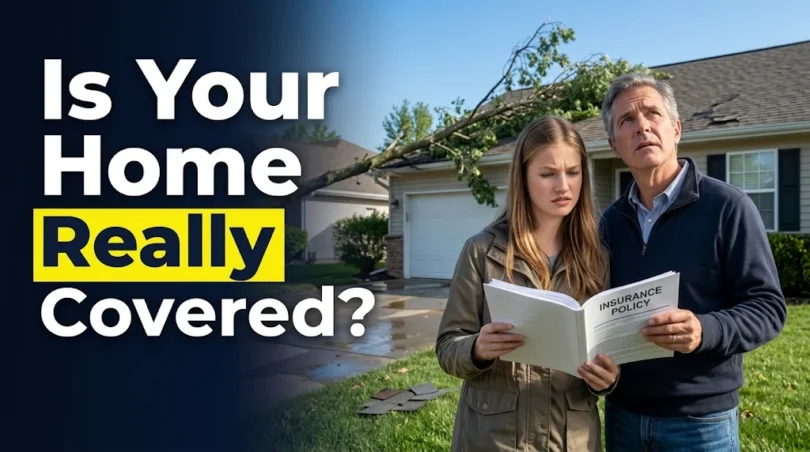

A standard homeowners insurance policy covers four main things: damage to your house, damage to other structures on your property, your personal belongings, and your liability if someone is hurt or their property is damaged and you are responsible. It also pays extra living expenses if you have to move out during repairs, and small medical bills for guests hurt at your home. What it usually does not cover is flood, earthquake, normal wear and tear, pests and maintenance problems.
Knowing the difference matters more than ever. Home insurance costs averaged about $3,012 a year in 2026, according to Insurify, after years of increases driven by severe weather. When you are paying that much, you want to be sure the policy actually protects you. Here is a clear breakdown.
The Six Parts of a Standard Policy
Most homeowners policies in the U.S. follow a format called HO-3. Coverage is split into lettered sections.
| Coverage | What it protects | Typical limit |
|---|---|---|
| A. Dwelling | The structure of your home, including built in fixtures | Should equal the cost to rebuild |
| B. Other structures | Detached garages, sheds, fences, gazebos | Often 10% of Coverage A |
| C. Personal property | Furniture, clothes, electronics, belongings | Often 50% to 70% of Coverage A |
| D. Loss of use | Hotel, rent and extra costs while you can’t live at home | Often 20% to 30% of Coverage A |
| E. Personal liability | Lawsuits and damages if you’re responsible for injury or property damage | Commonly $100,000 to $500,000 |
| F. Medical payments | Small medical bills for guests hurt on your property, regardless of fault | Commonly $1,000 to $5,000 |
Coverage A: Your Dwelling
This is the heart of the policy. It pays to repair or rebuild your home if it is damaged by a covered peril, such as fire, lightning, windstorm, hail, a falling tree, the weight of snow or ice, or a burst pipe. It covers the structure itself plus attached parts like a deck, built in cabinets, plumbing, wiring and HVAC systems.
The most important number on your policy is your dwelling limit. It should reflect what it would cost to rebuild your home today, not what you paid for it or what it would sell for. Land isn’t included because it doesn’t burn down. Construction costs have risen a lot in recent years, so many homes are underinsured. Ask your insurer to recalculate your rebuild cost every year or two.
Coverage B: Other Structures
Detached structures like a garage, shed, fence, guesthouse or pool house are covered here, usually up to about 10 percent of your dwelling limit. If you have a large detached garage or workshop, that amount may not be enough. You can usually buy more.
Coverage C: Personal Property
Your belongings are covered whether they are inside your home or with you elsewhere, such as a laptop stolen from your car or luggage stolen while traveling. Off premises coverage is sometimes limited to a percentage of the total.
Special limits on valuables
Policies set low caps on certain items unless you schedule them separately. Common examples include:
- Jewelry and watches, often $1,500 to $2,500 total for theft
- Cash, often a few hundred dollars
- Firearms
- Silverware
- Collectibles, art and stamps
If you own an engagement ring worth $8,000, a theft might only pay a small fraction unless you add a scheduled personal property endorsement, sometimes called a rider.
Replacement cost vs actual cash value
Some policies pay replacement cost for belongings, meaning what it costs to buy a new equivalent item. Others pay actual cash value, which subtracts depreciation. A five year old TV might only be worth a fraction of its original price under actual cash value. Replacement cost coverage costs a little more but usually pays much better.
Coverage D: Loss of Use
If a covered problem makes your home unlivable, this pays for additional living expenses. That can include hotel bills or rent, restaurant meals above your normal grocery costs, laundry, extra mileage and pet boarding. It only covers costs above what you normally spend. Keep every receipt.
Coverage E: Personal Liability
Liability coverage protects you if you are legally responsible for someone else’s injury or property damage. Examples include a guest slipping on your icy steps, your dog biting a neighbor, or your child accidentally breaking a neighbor’s window. It pays for damages and your legal defense costs. It often applies away from home too, such as if you accidentally injure someone while playing golf.
Many experts suggest at least $300,000 in liability coverage, and more if you have significant assets. For extra protection, an umbrella policy can add $1 million or more at a relatively low cost.
Coverage F: Medical Payments to Others
This pays small medical bills for guests injured on your property, regardless of who was at fault. It helps resolve minor injuries quickly without a liability claim. It doesn’t cover you or people who live in your home.
What Homeowners Insurance Usually Doesn’t Cover
| Not covered | How to get protection |
|---|---|
| Flooding from rising water | Separate flood policy from the NFIP or a private insurer |
| Earthquakes | Separate earthquake policy or endorsement |
| Sewer or drain backup | Water backup endorsement |
| Wear and tear, old roofs, maintenance problems | Not insurable; regular maintenance is your job |
| Termites, rodents and insects | Not covered; pest control is maintenance |
| Mold from long term leaks | Often excluded or limited; fix leaks quickly |
| Business property and liability | Home business endorsement or business policy |
| Short term rentals | Special endorsement or host coverage |
| Intentional damage | Never covered |
Flood is the biggest gap. Standard policies don’t cover flooding from rain, storm surge or overflowing rivers, even though flooding is one of the most common and costly disasters in the country. If you live anywhere it rains heavily, it is worth checking flood insurance prices.
Named Perils vs Open Perils
An HO-3 policy usually covers your home’s structure on an open perils basis. That means everything is covered unless the policy specifically excludes it. Your belongings are usually covered on a named perils basis, meaning only the causes listed in the policy, such as fire, theft, windstorm, smoke and vandalism, are covered. Upgrading to an HO-5 policy typically gives open perils coverage for belongings too.
Deductibles, Including Wind and Hurricane Deductibles
Your deductible is the amount you pay before insurance kicks in. Many policies use a flat deductible, such as $1,000 or $2,500. In hurricane and hail prone areas, policies often include a separate percentage deductible for wind or hurricane damage, commonly 1 to 5 percent of your dwelling limit. On a home insured for $400,000, a 2 percent hurricane deductible means you pay the first $8,000. Know this number before storm season.
Extra Endorsements Worth Considering
Endorsements are add ons that expand your coverage. A few are especially useful:
- Extended or guaranteed replacement cost: pays above your dwelling limit, often 20 to 50 percent more, if rebuilding costs surge after a disaster.
- Ordinance or law coverage: pays to bring a damaged older home up to current building codes during repairs, which standard policies often limit.
- Water backup: covers damage when sewers or drains back up into your home.
- Equipment breakdown: covers sudden failure of systems like HVAC or appliances.
- Service line coverage: covers damage to underground water, sewer or power lines running to your home.
- Scheduled personal property: covers valuables at their appraised value, often with no deductible.
Why Your Premium Keeps Rising
Home insurance rates rose 2.2 percent nationally in the first half of 2026, with much bigger jumps in some states, including about 12.9 percent in Minnesota and 8.6 percent in Louisiana, according to Insurify. The main reasons are severe weather, including hail and windstorms, plus higher construction and labor costs. Many insurers have also tightened rules on older roofs, raised deductibles or stopped renewing policies in high risk areas. Shopping around, raising your deductible and making your home more resistant to storms can help keep costs in check.
A Quick Example
A pipe bursts in Denise’s upstairs bathroom in Atlanta while she is at work. Water ruins the ceiling, floors and drywall below, plus a couch and a TV. Her family stays in a short term rental for three weeks during repairs. Her homeowners policy pays to tear out and replace the damaged drywall and floors under Coverage A, replaces the couch and TV under Coverage C, and pays the rental and extra meal costs under Coverage D, minus her $1,000 deductible.
What it doesn’t pay for is the old, corroded pipe itself, since that was wear and tear. And if the water had come from a flooded creek instead of a pipe, she would have needed flood insurance.
Common Claim Surprises
Homeowners are often caught off guard by a few situations:
- Roof claims paid at depreciated value. Some policies pay only actual cash value for older roofs, so a 15 year old roof may get a much smaller payout than a new roof would cost.
- Cosmetic damage exclusions. Some policies exclude hail dents on metal roofs or siding that don’t cause leaks.
- Vacancy rules. Coverage for some causes of loss can be limited if a home sits empty for more than 30 to 60 days.
- Matching. When only part of a floor or siding is damaged, policies and states differ on whether the insurer must pay to make the whole area match.
Reading the exclusions and endorsements sections of your policy is the best way to avoid these surprises.
How to Make Sure You’re Properly Covered
- Confirm your dwelling limit matches today’s rebuild cost
- Choose replacement cost coverage for belongings if you can
- Schedule valuable jewelry, art and collectibles
- Consider water backup and extended replacement cost endorsements
- Check flood and earthquake risk for your address
- Carry enough liability coverage for your assets
- Make a home inventory with photos or video of every room
- Review your policy every year, especially after renovations
What to Do Next
Find your policy’s declarations page and check each of the six coverage limits, your deductibles and any special wind or hurricane deductible. Then read the exclusions section. If you see gaps, like no water backup or no flood coverage, ask your agent for a quote to close them. A few minutes now can prevent a very expensive surprise later.
Sources
- Insurance Information Institute: Homeowners Insurance Basics
- Insurify: Home Insurance Rates Increase in First Half of 2026
- FEMA: National Flood Insurance Program
- NAIC: A Consumer’s Guide to Home Insurance
This article is for general information only and is not insurance, financial or legal advice. Coverage, prices and rules vary by state, insurer and policy. Read your own policy and talk with a licensed insurance agent or professional about your situation.
Frequently Asked Questions
Does homeowners insurance cover my belongings in a storage unit?
Often yes, under off premises personal property coverage, though the limit may be a percentage of your total personal property coverage.
Does homeowners insurance cover a dog bite?
Usually yes, under personal liability coverage, though some insurers exclude certain breeds or dogs with a bite history.
Does homeowners insurance cover roof replacement?
It covers roof damage from covered perils like wind, hail or a falling tree. It doesn’t cover a roof that simply wore out with age.
Does homeowners insurance cover flooding?
No. Flooding from rising water requires a separate flood insurance policy.
Does homeowners insurance cover theft outside the home?
Usually yes. Personal property coverage often applies to belongings stolen away from home, sometimes with a lower limit.
What is the difference between HO-3 and HO-5?
Both cover the home on an open perils basis. HO-5 also covers belongings on an open perils basis and often pays replacement cost.
Is homeowners insurance required?
No law requires it, but mortgage lenders almost always require it as a condition of the loan.
Does homeowners insurance cover mold?
Sometimes, if it results from a covered sudden event like a burst pipe. Mold from long term leaks or poor maintenance is usually excluded.
How much dwelling coverage do I need?
Enough to rebuild your home at today’s construction costs, which is different from its market value or purchase price.